Key Features
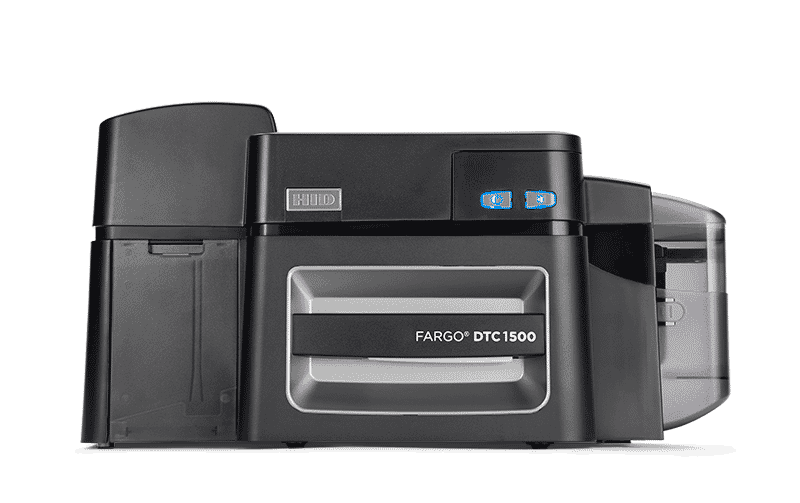
HID FARGO DTC1500 Single-Sided Card Printer (Base Model with USB & Ethernet Module)
The DTC1500 is the latest innovative card printer with increased security and lower cost but higher capacity consumables. It is extremely versatile and best of all, earth-friendly.
- Fast printing
- Easy to use
- Sets up in 5 minutes
- Quick load ribbon spindles
- Three Year Warranty
- Includes our Printer Service Guarantee
- This card printer package comes as USB and Ethernet
Important Note: This printer is factory configured for dual-sided printing. If purchased as a single-sided option, an RFID activation is required to enable dual-sided functionality.
SKU: HPF-DTC1500
FAQs
What is the difference between DTC and HDP ID card printers?
DTC (Direct-to-Card) and HDP (High Definition Print) are two different methods of how an image/text is printed onto a card by the ID Card Printer, which directly impacts the quality, durability, and cost of the printing.
DTC (Direct-to-Card) Printers
DTC printers apply the image directly onto the surface of the card using a printhead and ribbon.
Key benefits:
- Cost-effective (lower purchase and running cost – entry level friendly)
- Faster printing speeds compared to HDP printers
- Ideal for standard PVC cards (staff IDs, student cards, membership cards)
Limitations:
- Leaves a very slight white border around the edge/boarder or the card – different from HDP printers which is edge-to-edge printing.
- Requires smooth, flat cards therefore not ideal for printing onto smart cards
- Print has a basic overlay, so it can be less durable over time, unlike HDP printing which offers a more protective layer over the print.
Best for: Everyday ID cards where cost and speed matters over high quality print.
HDP (High Definition / Retransfer) Printers
HDP printers use a two-step retransfer process. The image is printed onto a clear film and then the film is fused onto the card surface
Key benefits:
- Sharp and rich print quality
- True edge-to-edge (aka full-bleed) printing
- Because the image is printed onto a film first, then the film is then fused to the card, you can print on uneven surfaces (e.g. smart cards, prox cards)
- More durable cards thanks to the protective film layer
Limitations:
- Higher upfront and running cost
- Slightly slower printing process than that of a DTC printer
Best for: High-security, premium or smart card applications.
What type of cards can the HID FARGO DTC1500 ID Card Printer print?
The HID FARGO DTC1500 ID Card Printer is a direct-to-card printer (DTC) designed to produce high-quality plastic (PVC) ID cards, including employee badges, student IDs, membership cards, and access control cards. It supports standard CR-80 and CR-79 card sizes and a range of card materials.
What security features does the DTC1500 offer?
The DTC1500 includes advanced built-in security features such as custom watermark overlays, password protection, resin data scramble, and AES-256 data encryption. These features help protect cardholder data and reduce the risk of counterfeiting.
What is the difference between single-sided and dual-sided printing?
Single-sided printers print on the front of the card only, making them ideal for basic ID cards with minimal information. Dual-sided printers print on both sides of the card automatically, allowing for additional details such as barcodes, terms and conditions, or security elements.
The DTC1500 is modular, meaning single-sided models can be upgraded to dual-sided printing when your needs grow.
Can the DTC1500 be upgraded from single-side to dual-side printing after purchase?
Yes, the DTC1500 features a modular design that allows for easy upgrades. You can add dual-sided printing, lamination, or card encoding options after purchase, making it a flexible solution for growing organisations.
Is the DTC1500 suitable for high-volume card printing?
Yes, the DTC1500 is designed for reliable, ongoing card issuance with high-capacity consumables, helping reduce downtime and cost per card. It’s well-suited for schools, government, healthcare, and business environments that require consistent card printing.