


We provide a broad spectrum of customisable and off-the-shelf security and identification solutions. From ID card printers to tailored PVC cards and visitor management systems, our offerings are backed by partnerships with industry-leading brands. Our commitment to excellence is further highlighted by our competitive price guarantee, ensuring unparalleled client satisfaction.
We provide a broad spectrum of customisable and off-the-shelf security and identification solutions. From ID card printers to tailored PVC cards and visitor management systems, our offerings are backed by partnerships with industry-leading brands. Our commitment to excellence is further highlighted by our competitive price guarantee, ensuring unparalleled client satisfaction.
We provide a broad spectrum of customisable and off-the-shelf security and identification solutions. From ID card printers to tailored PVC cards and visitor management systems, our offerings are backed by partnerships with industry-leading brands. Our commitment to excellence is further highlighted by our competitive price guarantee, ensuring unparalleled client satisfaction.
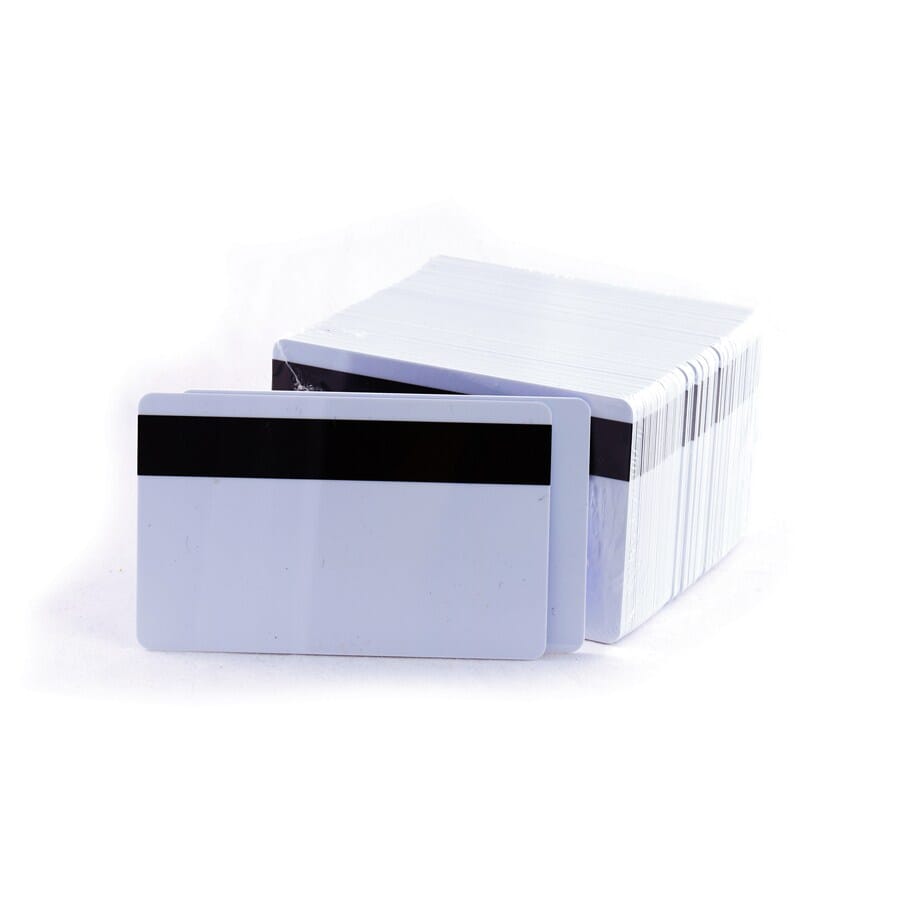
$0.53
White LoCo Magnetic Stripe PVC Card (300oe) – CR80
In stock
SKU: CAR417
Poly Composite Cards (PCC) are high-performance ID cards engineered for durability and heat resistance. They are constructed with multiple layers, typically featuring a PET (Polyethylene Terephthalate) core for strength and heat tolerance, and PVC outer layers that provide a smooth surface for high-quality printing.
This layered design makes PCCs especially suitable for retransfer printing, which involves high heat to fuse the printed image onto the card. Unlike standard PVC cards, Poly Composite Cards maintain their shape and integrity during the retransfer process, making them ideal for high-volume or high-security applications.
Polyvinyl Chloride (PVC) is a synthetic plastic polymer made from vinyl chloride monomers. It’s one of the most widely used plastics globally, found in products ranging from plumbing pipes to credit cards. In the ID card industry, PVC is valued for its affordability, printability, and flexibility, making it a popular choice for employee badges, student IDs, and loyalty cards.
PVC Cards are compatible with most desktop card printers, however, they are not recommended for retransfer printing, as they can warp or deform under the high heat used in that process.
CR80 and CR79 are terms used in the security and identification industry for the size of PVC and PCC cards. CR80 is the industry standard or “default” ID card size, the same size as a credit card. It is the most common ID card size in the industry and the most printer‑compatible format. The dimensions for CR80 cards are 85.6 mm × 54 mm.
CR79 cards are slightly smaller than CR80 and are most commonly adhesive cards (paper‑ or Mylar‑backed cards). They are intentionally designed to be smaller so that, when adhered to another card, such as a technology card, they do not overhang the edges. The dimensions for CR79 cards are 83.9 mm × 51 mm.
If your card printing setup includes a retransfer printer or you need cards that can withstand frequent use and environmental stress, Poly Composite Cards are the superior choice. For general-purpose ID cards in standard office settings, PVC Cards offer excellent value and print quality.
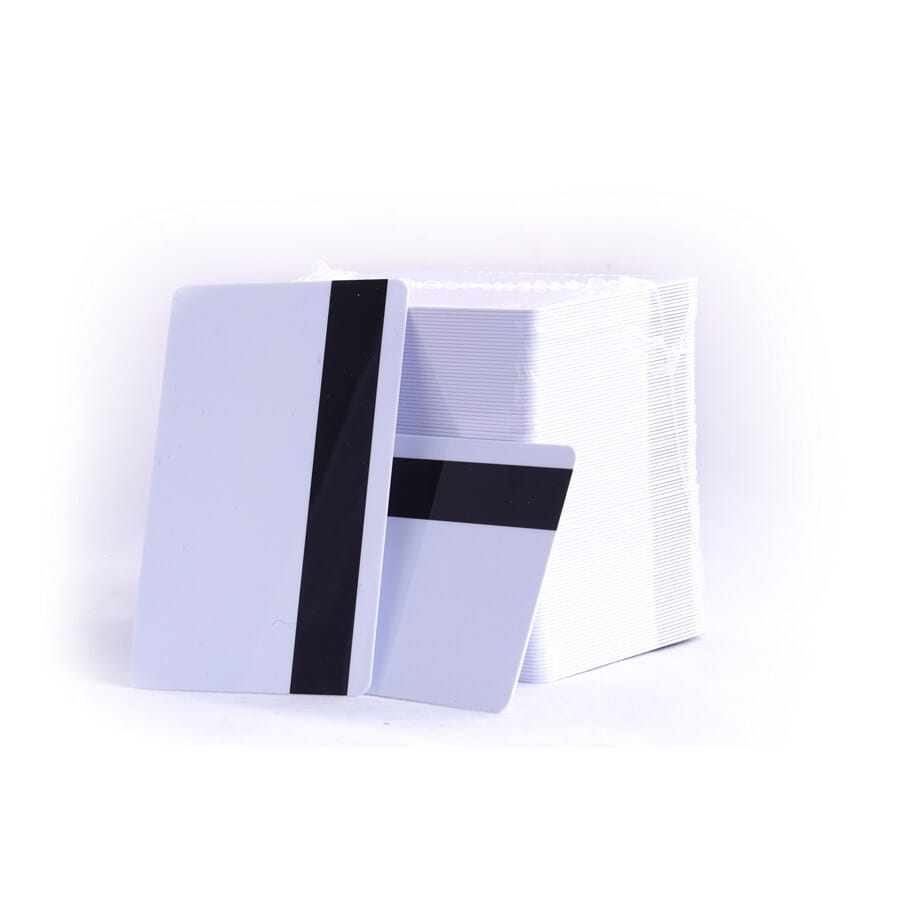
A magnetic stripe, AKA a mag stripe, is the black or brown strip on the back of a plastic card that stores data as magnetised particles, which are read when the card is swiped through a compatible reader. When the card is swiped, the reader decodes the information stored in the stripe to identify a user, grant access, or record a transaction. Magnetic stripes are commonly used for access control cards, membership and loyalty cards, staff time & attendance cards, hotel key cards, gift cards and ID cards.
LoCo stands for Low Coercivity, and HiCo stands for High Coercivity. Coercivity is a measure of how resistant a magnetic material is to being erased or demagnetised. In the context of magnetic stripe cards, coercivity is a measure of how strong the magnetic stripe is and how much magnetic force is required to change or erase the data stored on it. Therefore, the key difference between LoCo and HiCo magnetic stripe cards is the strength.
Oersted (Oe) is a unit of measurement for magnetic field strength. The coercivity (strength) of a magnetic stripe is measured in Oersted (Oe). A higher Oersted value means a stronger magnetic stripe. A lower Oersted value means a weaker magnetic stripe.
The magnetic stripe is located on one side of the card only, almost always on the back side, not both sides.
Yes, you can print on the blank side of the card first and then send the cards away for magnetic stripe encoding later. If also printing on the magnetic stripe side, do NOT print or laminate over the magnetic stripe.
The magnetic stripe on your cards must be left completely clear of Ink, lamination, and retransfer film to ensure reliable encoding or reading later. Most ID card printers automatically avoid the stripe zone, but it’s still very important that your artwork doesn’t overlap it. Keep all text, images, and barcodes away from the mag stripe area on your artwork. Use your printer’s mag‑stripe template or “no‑print zone” if available.
LoCo (300 Oe) stripes are more susceptible to accidental demagnetisation. Strong magnets and excessive heat can weaken or erase the stripe before it’s encoded, so keep the cards away from strong magnets and heat. Although it’s best to keep magnetic tripe cards away from excessive heat, LoCo magnetic stripe cards can still be printed using HDP (retransfer) printers, provided the magnetic stripe area is left clear, and no laminate or print is applied over the stripe. Use a partial laminate or no laminate over the side of the card with the mag stripe.
Use clean, well‑maintained printer rollers. Dirty rollers or debris inside a printer can scratch the mag stripe as the card passes through. It’s also good practice to hold PVC cards by the edges only to avoid fingerprints and oils on the surface, which can affect the adhesion of ink and laminate.
If you are printing and encoding your cards, an ID card printer with a magnetic stripe encoder capable of encoding LoCo (300 Oe) cards is required. If you are only printing on your cards and sending them for encoding externally, you don’t need an ID card printer with an encoder.
The ID Card Printer models below can print and encode LoCo magnetic stripe cards, provided the magnetic encoder is installed;
| Card Size | CR80 (86mm x 54mm) |
|---|---|
| Pack Height (cm) | 7 |
| Pack Width (cm) | 10 |
| Pack Length (cm) | 10 |
| Pack Weight (kgs) | 0.5 |
| Pack Size | 100 |
| Card Type | LoCo Mag Stripe |
| Card Thickness | 30mil |
| Colour | White |
| GTIN/UPC | 754563817505 |

Select at least 2 products
to compare